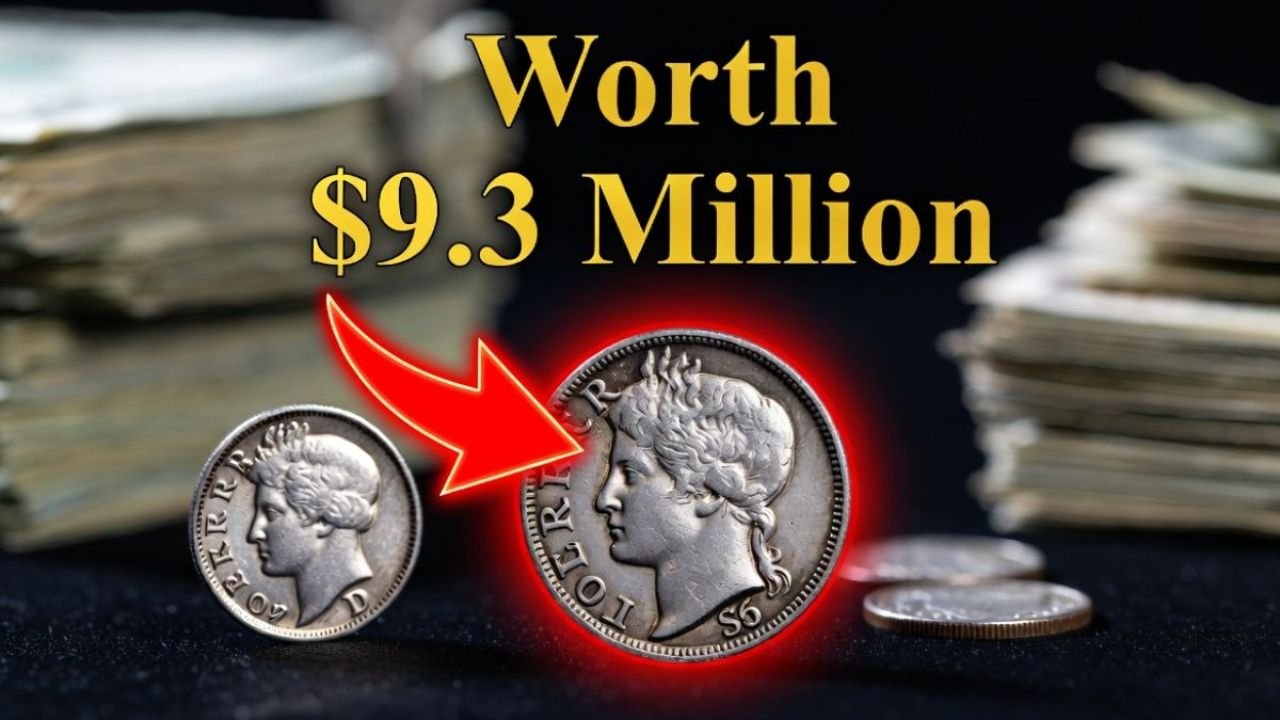
In the world of coin collecting, even the smallest denominations can hold remarkable value. The humble U.S. dime, often overlooked in everyday transactions, has produced some of the rarest and most sought-after coins in American numismatic history. While most dimes remain worth just ten cents, certain rare issues—defined by extremely low mintage numbers, minting errors, or historical significance—can command extraordinary prices in the collector market.
In fact, some rare dimes have sold for hundreds of thousands or even millions of dollars at major auctions. For collectors and investors in 2026, understanding which coins carry this potential can transform an ordinary coin jar into an unexpected treasure hunt.
Below are five of the rarest and most valuable U.S. dimes that collectors continue to search for today.
Why Some Dimes Become Extremely Valuable
Not every coin gains collector value. A dime becomes exceptionally valuable only when several key factors combine.
The first factor is rarity. Coins produced in extremely limited numbers naturally attract strong collector demand, especially when only a handful survive today.

Another major factor is minting errors. Occasionally, mistakes occur during the production process such as missing mint marks or incorrect dates, creating unique varieties that collectors consider highly desirable.
Metal composition also matters. Older U.S. dimes were produced using silver, giving them intrinsic value beyond their face denomination.
Finally, condition plays a critical role. Coins preserved in near-perfect condition often command dramatically higher prices than worn examples.
1. 1894-S Barber Dime – One of the Greatest Rarities in U.S. Coinage
The 1894-S Barber Dime is widely considered one of the most legendary coins in American numismatics. Minted in San Francisco, this coin had an incredibly small production run—only 24 pieces are believed to have been struck.
Today, fewer than ten examples are known to exist.
The reason for this tiny mintage remains a mystery. Some historians believe the coins were produced as presentation pieces, while others suggest they were minted to balance accounting records at the San Francisco Mint.
One famous story claims that a mint official gave several of these coins to his daughter, who later spent one on ice cream.
Regardless of the story’s accuracy, the coin’s rarity has made it immensely valuable. Well-preserved examples have sold for nearly $2 million, and experts believe future sales could reach even higher levels.
2. 1916-D Mercury Dime – A Key Date for Collectors
The 1916-D Mercury Dime is another iconic rarity that holds an essential place in American coin collections.
During its first year of production, the Denver Mint struck only about 264,000 Mercury dimes. This extremely low mintage makes it the key date of the entire Mercury dime series.
The coin features a portrait often mistaken for the Roman god Mercury but actually represents Liberty wearing a winged cap, symbolizing freedom of thought.
Collectors identify this coin by the small “D” mint mark located on the reverse side.
Because of its rarity and historical significance, even heavily circulated examples can sell for thousands of dollars. In exceptional condition, these coins may reach prices well above $100,000.
3. 1975 No-S Roosevelt Dime – A Proof Coin Error
Minting errors sometimes create the most valuable coins in modern history. One of the most famous examples is the 1975 No-S Roosevelt Dime.
Proof coins produced for collectors are typically struck at the San Francisco Mint and carry an “S” mint mark. However, a small number of 1975 proof dimes were accidentally released without this mark.
To date, only two verified examples are known.
Because of this extreme rarity, the coin has become one of the most valuable modern U.S. coins ever discovered. One specimen sold for more than $450,000, and experts believe its value could continue rising as collector demand grows.
4. 1968 No-S Roosevelt Dime – Another Rare Proof Variety
A similar minting mistake occurred several years earlier with the 1968 No-S Roosevelt Dime.
Like the 1975 version, proof coins from 1968 were supposed to include the San Francisco “S” mint mark. However, a small number were struck without the mark due to a production oversight.
Although more examples exist compared with the 1975 variety, they are still extremely rare.
Collectors often discover these coins in old proof sets that have been stored for decades without careful inspection.
Depending on their condition, verified examples of the 1968 No-S Roosevelt Dime can sell for $30,000 to $100,000 or more in today’s collector market.
5. 1942/1 Mercury Dime – The Famous Overdate Error
The 1942/1 Mercury Dime is one of the most recognizable error coins in the Mercury series.
This coin displays an overdate error, where the number “1” from the original 1941 date is visible beneath the “2” in 1942. The mistake occurred when a previously dated die was reused and modified for the new year.
Under magnification, collectors can clearly see the overlapping numbers.
Because only a limited number of these coins entered circulation, the variety has become highly collectible.
Prices vary depending on condition, but even moderately preserved examples can sell for thousands of dollars. High-grade specimens may reach values between $10,000 and $75,000.
Could a Rare Dime Be Hiding in Your Collection?
Although these coins are extremely rare, they continue to surface in unexpected places.
Many valuable coins are discovered in inherited collections, old coin albums, forgotten piggy banks, or boxes stored away for decades.
Because most people do not closely examine their coins, rare pieces sometimes remain unnoticed for years.
For collectors and hobbyists, the possibility of such discoveries adds excitement to the search for rare coins.
How to Identify Potentially Valuable Dimes
If you want to check whether your dimes might be valuable, a few simple steps can help.
First, examine the coin’s date and mint mark carefully. These details often determine whether a coin belongs to a rare variety.
Next, inspect the coin for unusual features such as missing mint marks, doubled numbers, or overlapping dates.
Using a magnifying glass or jeweler’s loupe can make these details much easier to see.
Finally, consider professional evaluation. Reputable coin grading services can authenticate rare coins and determine their condition, which significantly influences their market value.
The Fascination of Small Coins With Big Value
The rare dimes highlighted above demonstrate how history, craftsmanship, and chance can combine to create extraordinary collectibles. What appears to be an ordinary ten-cent coin can sometimes hold remarkable value due to rarity, historical context, or minting mistakes.
For collectors in 2026, the search for these coins continues to capture imagination around the world. Whether discovered in a family collection or purchased at auction, rare dimes represent a unique blend of history and financial opportunity.
The next time you come across an old dime, it may be worth taking a closer look—because hidden among everyday coins could be a small piece of history worth a fortune.