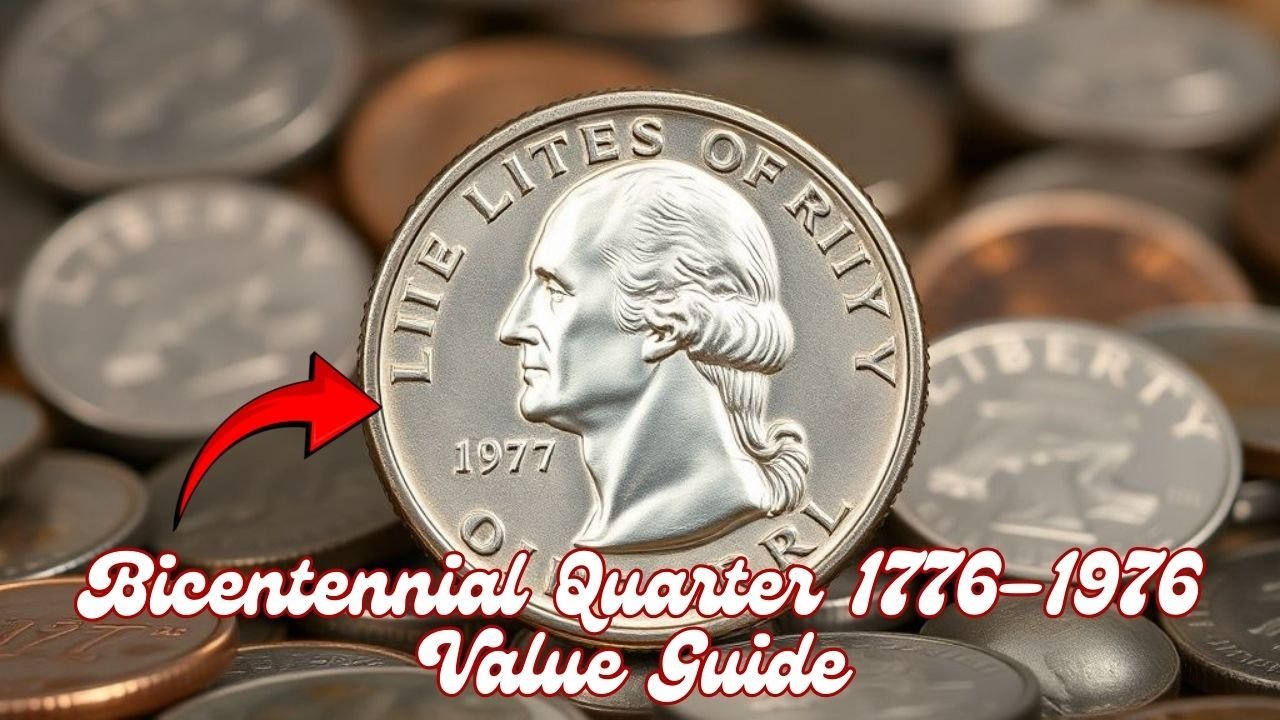
Few modern U.S. coins are as instantly recognizable as the Bicentennial Quarter. Issued to commemorate the 200th anniversary of American independence, the 1776–1976 quarter introduced a special reverse design and became one of the most widely collected commemorative coins in the country’s history.
Although millions of Bicentennial Quarters were produced, most remain worth only their face value. However, certain varieties—especially silver editions, rare minting errors, and exceptionally high-grade examples—have captured the attention of serious collectors. Understanding these differences can help identify whether a Bicentennial Quarter is a common coin or a valuable collectible.
The Historical Background of the Bicentennial Quarter
The United States celebrated its bicentennial in 1976, marking two centuries since the signing of the Declaration of Independence. To honor the occasion, the U.S. Mint released a series of commemorative coins including the quarter, half dollar, and dollar.
Unlike traditional coins that carry a single year, Bicentennial Quarters feature dual dates—1776–1976—symbolizing the nation’s founding and its 200th anniversary.
The reverse design was created by artist Jack L. Ahr and features a colonial drummer boy accompanied by a torch surrounded by thirteen stars representing the original American colonies. This design replaced the traditional eagle reverse used on earlier Washington quarters.

On the obverse side, the familiar portrait of President George Washington remained unchanged, maintaining continuity with the original Washington Quarter design first introduced in 1932.
The combination of patriotic symbolism and distinctive design made the Bicentennial Quarter one of the most memorable coins of the modern era.
Where Bicentennial Quarters Were Minted
Bicentennial Quarters were produced at three major U.S. Mint facilities, each identifiable by its mint mark.
Philadelphia Mint
Coins produced in Philadelphia carry no mint mark. These were primarily intended for circulation and were produced in very large quantities.
Denver Mint
Denver Mint coins carry a small “D” mint mark. Like Philadelphia issues, these coins were struck for general circulation and are widely available today.
San Francisco Mint
San Francisco produced special collector versions, including proof coins and silver issues. These coins carry an “S” mint mark and are often more valuable due to their limited production and higher quality finish.
Standard Circulation Bicentennial Quarters
The vast majority of Bicentennial Quarters were struck in copper-nickel clad composition and entered everyday circulation. Because of the extremely high mintage numbers, these coins are still commonly found in pocket change, coin jars, and bank rolls.
In circulated condition, most of these coins remain worth their face value of 25 cents. However, uncirculated examples with strong detail and original mint luster may sell for a small premium, typically between one and three dollars depending on condition.
Collectors sometimes seek these coins to complete date-and-mint sets, but they are generally considered common.
Silver Bicentennial Quarters
Among the most desirable Bicentennial Quarters are those struck in 40 percent silver. These coins were produced specifically for collector sets rather than for everyday circulation.
Silver Proof Coins
Silver proof Bicentennial Quarters were minted at the San Francisco Mint and included in special collector proof sets. These coins feature a highly polished, mirror-like finish and sharp design details.
Because of their limited production and precious metal content, silver proof quarters typically carry values higher than standard circulation coins. Depending on condition and market demand, these coins often sell for approximately $6 to $25 or more.
Silver Special Mint Set (SMS) Coins
Another collectible variety is the Silver Special Mint Set version. These coins feature a satin-like surface rather than the mirror finish seen on proof coins.
Although they were also produced for collectors, the distinctive finish and relatively lower availability make them attractive to specialized collectors.
High-grade silver SMS coins with strong visual appeal can sell for $50 to $100 or more, especially when professionally graded.
Rare Bicentennial Quarter Errors
Mint errors are among the most exciting discoveries for coin collectors. These unusual variations occur during the minting process and can transform an otherwise common coin into a rare collectible.
Wrong Planchet Errors
Occasionally, coins are struck on the wrong metal blank, known as a planchet. For example, a Bicentennial Quarter might be struck on a silver planchet intended for a collector set or on a planchet designed for another denomination.
These rare errors are highly collectible and can sell for hundreds or even thousands of dollars depending on their rarity and condition.
Doubled Die Errors
A doubled die occurs when the coin’s design appears duplicated due to a misalignment during the die creation process. This often results in noticeable doubling in letters, numbers, or design elements.
Although not extremely common, certified doubled die Bicentennial Quarters can command strong collector premiums.
Off-Center Strikes
An off-center strike happens when the coin blank is not properly aligned when struck by the dies. This results in a portion of the design being missing while another portion appears shifted toward the edge.
Coins with dramatic off-center strikes often attract collector interest, with values depending on the percentage of the design affected.
Broadstrike Errors
Broadstrike errors occur when a coin is struck without the restraining collar that normally shapes the coin’s edge. The result is a coin that spreads outward, often appearing slightly larger and thinner than normal.
Such unusual minting results can make the coin significantly more collectible.
The Importance of Professional Grading
One of the most important factors influencing coin value is its condition. Professional grading services evaluate coins based on surface quality, strike strength, and overall preservation.
Coins are graded using a scale from 1 to 70, with higher numbers representing better condition.
Coins graded in the Mint State range—especially MS65 or higher—are considered uncirculated and often command higher market prices.
For Bicentennial Quarters, extremely high-grade examples graded MS68 or above are relatively scarce. Perfect coins graded MS70 or Proof 70 are even rarer and may achieve significant premiums at auction.
Professional certification also provides authentication and protective encapsulation, which helps preserve the coin’s condition and increases buyer confidence.
Collector Strategies for Finding Valuable Bicentennial Quarters
Collectors hoping to discover valuable Bicentennial Quarters can improve their chances by following a few practical strategies.
Start by carefully examining coins using a magnifying glass or loupe. Many valuable varieties feature subtle details that are difficult to see with the naked eye.
Check the mint mark, which can indicate whether the coin may belong to a collector series such as the San Francisco proofs.
Look closely for unusual features such as doubled lettering, off-center strikes, or unusual coloration that might indicate a planchet error.
Studying recent auction results can also provide insight into current market values and help collectors identify desirable varieties.
Finally, proper storage is essential. Coins should be kept in protective holders, albums, or capsules to prevent scratches, environmental damage, or surface contamination.
Why Bicentennial Quarters Continue to Fascinate Collectors
Nearly half a century after their release, Bicentennial Quarters remain one of the most widely recognized commemorative coins in American history. Their distinctive design, patriotic symbolism, and historical significance continue to attract both beginner collectors and experienced numismatists.
While most examples remain common, certain varieties—including silver issues, rare mint errors, and exceptionally preserved coins—have demonstrated that even modern coins can hold meaningful collector value.
For those willing to examine their coins carefully, the Bicentennial Quarter offers an exciting opportunity to explore history, artistry, and the thrill of discovering hidden treasures within everyday currency.